


Intercom vs a Standalone AI Support Agent: Which Is Right for Your Team?
A direct comparison of Intercom's native AI (Fin) vs. a standalone AI support agent — covering resolution quality, cost, switching costs, and when each wins.
Intercom has become one of the dominant platforms for customer communication and support. Its embedded AI, Fin, is a genuinely capable product — not a chatbot bolted on as an afterthought, but a first-class feature built by a company that has invested seriously in AI for customer service. For many teams, Fin inside Intercom is the right answer.
For others, it’s not. The reasons are worth understanding clearly before you make a decision that’s not easy to reverse.
This article is a direct, practical comparison between running with Intercom’s AI capabilities and deploying a standalone AI support agent alongside (or instead of) Intercom. It is not a vendor hit piece — Intercom is a strong product. It is an honest evaluation of when each approach wins, what the tradeoffs actually cost, and how to think through the decision for your specific context.
What Intercom Provides Natively
Intercom is a customer communication platform first — messaging, ticketing, and CRM are the foundation. AI capabilities are layered on top of that foundation.
Fin AI: Intercom’s flagship AI agent. Fin can answer customer questions using your knowledge base content, handle multi-turn conversations, and escalate to human agents when it cannot resolve an inquiry. It is integrated natively into the Intercom messenger, has access to Intercom’s conversation history, and operates within the same interface your agents use. For many support teams, this integration is the primary appeal.
Copilot: AI assistance for human agents — surfacing suggested responses, pulling relevant documentation, and drafting replies. This is agent-facing, not customer-facing.
AI Insights and reporting: Intercom’s reporting layer includes AI-powered summaries, topic extraction across conversations, and CSAT analytics.
Ticketing system: Intercom has evolved from a pure messaging platform to include structured ticketing, with workflows, SLA management, and queue management.
Messenger and messaging channels: the core interface — web messenger, in-app messaging, WhatsApp, SMS, and email, all routed through Intercom’s inbox.
The strength of Intercom’s native AI is its depth of integration with the rest of the platform. Fin has access to conversation history, customer data stored in Intercom, and the full CRM context without any custom integration work. If Fin’s resolution quality meets your needs, that integration advantage is real.
What a Standalone AI Support Layer Provides
A standalone AI support agent operates as a purpose-built resolution layer, typically sitting in front of or alongside your existing support platform — whether that’s Intercom, Zendesk, Freshdesk, or something else.
Purpose-built resolution logic: standalone AI agents are built specifically for support resolution, not as one feature among many in a broader customer communication suite. The model, the knowledge retrieval architecture, and the escalation design reflect a singular focus on answering customer questions accurately.
Flexible knowledge base grounding: standalone agents typically support richer knowledge base configurations — multiple content sources, version control, content quality scoring — giving teams more control over what the AI knows and how it retrieves answers.
Deeper CRM and third-party integration: standalone agents are often designed to pull from multiple data sources simultaneously — your order management system, your CRM, your product database — to resolve queries that require cross-system context. This is harder to configure in embedded AI that’s primarily designed to work within one platform’s ecosystem.
Independent of your messaging platform: if your primary support interface is Intercom but your AI resolution needs to work across other channels (a mobile SDK, a third-party chat widget on a partner site), a standalone agent can be deployed across those surfaces without being constrained by Intercom’s channel ecosystem.
Separate quality and testing pipeline: because the AI is a distinct product, it typically has its own testing environment, staging deployment, and quality review process. This allows teams to evaluate and update the AI’s responses without pushing changes through the broader platform.
The Embedded Suite Tradeoff: Convenience vs. Specialization
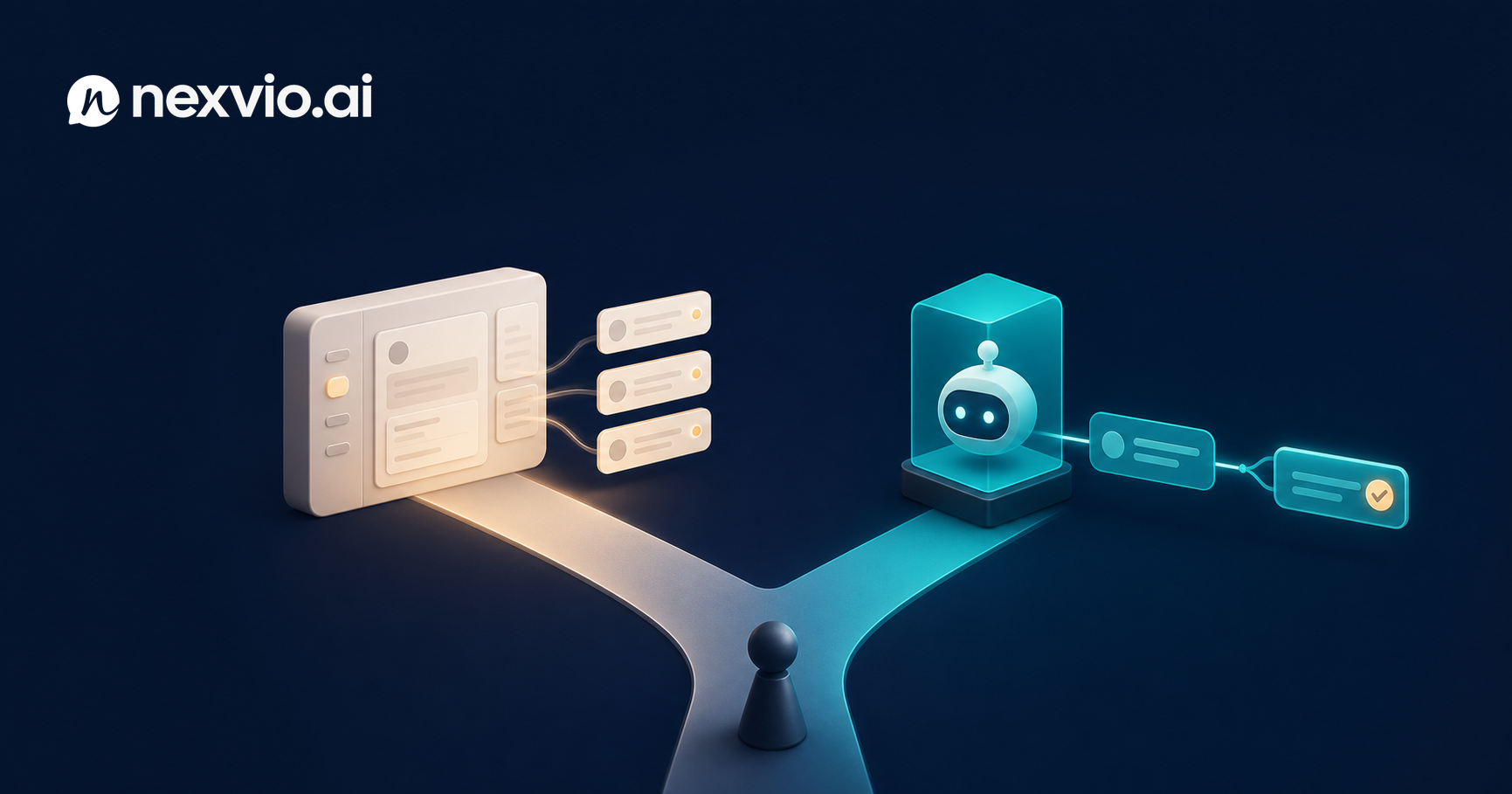
The fundamental tradeoff between Intercom + Fin and a standalone AI agent is the classic build-vs-buy tension applied to AI capabilities: do you want a deeply integrated solution that’s convenient to operate, or a specialized solution optimized for the outcome you care most about?
The case for embedded (Intercom + Fin):
- Single vendor, single contract, single interface for agents
- Native integration with conversation history, customer data, and routing
- No API integration work to connect the AI to your support platform
- Simpler operational model: one system to learn, one system to maintain
- Fin’s quality for straightforward FAQ and knowledge base queries is strong
The case for standalone:
- Resolution quality advantage on complex, multi-step, or multi-source queries
- Greater flexibility in knowledge base design and content management
- Independent scaling: upgrade your AI capability without changing your messaging platform
- Not locked to Intercom’s pricing model or product roadmap for AI improvements
- Better fit if your primary support surface is not Intercom’s messenger
The convenience argument for embedded is strongest when your support workflow is primarily messenger-based, your customer queries are FAQ-type, and your team doesn’t have bandwidth for a separate integration. The specialization argument for standalone wins when resolution quality is the primary metric and your queries require depth that a suite-level AI isn’t optimized for.
Resolution Quality Comparison: Generalist AI vs. Purpose-Built Support AI
Resolution quality is the metric that matters most. A chatbot that deflects tickets but doesn’t resolve them is not reducing support cost — it’s just delaying the ticket.
Intercom Fin is built on strong foundation models and performs well on direct, knowledge-base-answerable questions. For teams whose support volume is primarily FAQ-type — return policy, pricing questions, basic troubleshooting with documented steps — Fin’s resolution quality is competitive.
Where resolution quality gaps tend to emerge:
Multi-step troubleshooting: queries that require the AI to walk a customer through a diagnostic sequence, check conditions at each step, and adapt the path based on responses. This requires more sophisticated conversation management than pure retrieval-based AI.
Cross-system lookups: queries that require the AI to simultaneously consult order status, account tier, product configuration, and policy — pulling from three or four systems to construct a complete answer. Suite AI tends to be optimized for its own data ecosystem; cross-system queries require custom integration that standalone agents are often better architected for.
Policy edge cases: when the answer isn’t cleanly in the knowledge base and requires the AI to reason across multiple policy documents to construct an accurate answer. Retrieval quality differences between models are most visible here.
Localization and multilingual support: if your customer base is multinational, the depth of multilingual support varies. Evaluate specifically for the languages your customers use, not for “supports multiple languages” as a checkbox.
Transparency: any honest evaluation of AI resolution quality requires testing against your actual ticket types, not vendor-provided benchmarks. Request a pilot with real queries before drawing conclusions about which product performs better for your specific use case.
For a broader look at how AI chatbots for customer support compare across the market, see our overview of best AI chatbot builders for customer support.
Cost Model Differences: Suite Pricing vs. Usage-Based Specialist
Pricing models for Intercom and standalone AI agents differ structurally, which makes direct cost comparison complicated.
Intercom pricing: Intercom charges a base platform fee (per seat or per usage tier) that includes the broader suite — messaging, ticketing, CRM, analytics. Fin AI is priced separately, typically per resolution or as an add-on. If you’re already paying for Intercom, adding Fin may be a smaller incremental cost than switching to or adding a standalone agent.
Standalone AI pricing: standalone agents are typically priced per conversation, per resolution, or per month based on volume tier. The cost structure is more directly tied to AI usage — you pay more when the AI does more.
The ROI calculation for cost comparison:
- What is the current cost per resolved ticket (agent time × volume)?
- What is the AI resolution rate in your category — what percentage does the AI handle?
- What is the cost per AI-resolved ticket at your volume?
- What is the ticket deflection value (AI resolutions × cost difference vs. human-resolved)?
Run this calculation for both scenarios. Factor in the all-in cost for Intercom (platform + Fin + your current seat count), not just the incremental Fin add-on. Then factor in the all-in cost for a standalone agent (the standalone product + the cost of maintaining your existing messaging platform if you keep it).
The comparison is genuinely context-dependent. For teams already deeply invested in Intercom with a high percentage of straightforward queries, Fin’s incremental cost is often compelling. For teams with complex resolution requirements or who are evaluating their primary support platform, the standalone math can favor a purpose-built agent.
To see Nexvio’s transparent pricing against your actual volume, visit our pricing page.
Switching Costs and Migration Reality
The switching costs in this decision are real and should be factored honestly.
Switching away from Intercom entirely: if you’re considering replacing Intercom with a standalone AI + a different messaging/ticketing platform, the migration cost is significant. You’re migrating conversation history, customer data, agent workflows, and your team’s institutional knowledge of the platform. This is a six-to-twelve-month operational project, not a two-week configuration task.
Adding a standalone AI alongside Intercom: this is the more common path and has lower switching risk. You’re adding a capability layer, not replacing the platform. The integration work is primarily API configuration — connecting the AI to your knowledge base, your order management system, and your Intercom inbox. This is weeks of engineering work, not months.
Migrating from a standalone AI to Fin: simpler in some respects — you’re consolidating to a single vendor — but requires rebuilding knowledge base configurations within Intercom’s content architecture and re-testing resolution quality.
The migration reality most teams underestimate: the knowledge base migration. Whether you’re moving to or from any AI system, transferring, reformatting, and re-validating your knowledge base content for a new platform typically takes longer than the technical integration. Budget for this time explicitly.
When Intercom Is the Right Choice
Intercom + Fin is genuinely the right choice in several scenarios:
- Your support workflow is primarily messenger-based and your team lives in Intercom’s inbox
- Your query volume is predominantly FAQ-type with well-documented answers in your knowledge base
- You want to minimize vendor count and operational complexity
- You’re an earlier-stage company where a single platform for messaging, ticketing, and AI is operationally simpler
- You’ve already invested heavily in Intercom’s CRM and data infrastructure and don’t want to replicate that elsewhere
- Your budget is better suited to an incremental add-on cost than a separate standalone AI product
If these conditions describe your team, evaluate Fin seriously. The integration convenience is a real advantage that standalone products have to work to offset.
When a Standalone AI Layer Wins
A standalone AI support agent is the stronger choice when:
- Resolution quality on complex queries is the primary differentiator and your ticket mix includes multi-step troubleshooting, cross-system lookups, or policy edge cases
- Your support surfaces span beyond Intercom — you need the AI to operate on a native mobile SDK, a third-party site, or a channel that Intercom doesn’t serve
- You need deep integration with systems outside Intercom’s ecosystem — order management, custom product databases, internal tooling
- You want to evaluate your messaging platform independently of your AI capability — keeping them separate means you can upgrade either without being constrained by the other’s roadmap
- You have high-compliance requirements that a purpose-built enterprise AI product is better positioned to meet than a suite product’s AI add-on
The standalone case is also stronger when your team has bandwidth to manage two integrations and values specialization over consolidation.
The Hybrid: Using Both Together
The option that often gets overlooked: using Intercom for messaging, ticketing, and agent workflow while routing initial AI resolution through a standalone agent before conversations reach Intercom.
In this model, the standalone AI handles the first pass — resolving what it can, then creating enriched Intercom tickets for escalated conversations. Intercom’s Copilot assists agents on the escalated tickets. The result is a two-layer AI architecture: specialized resolution at the front, embedded agent assist at the back.
This approach adds complexity and cost but can deliver the best outcomes on both resolution quality and agent experience. It makes most sense for larger teams where the investment in optimization is justified by ticket volume.
For teams with significant scale, explore Nexvio’s enterprise capabilities and how the hybrid architecture is supported.
FAQ
Is Intercom Fin good enough for most support teams?
For teams whose primary support volume is FAQ-type and whose workflow is primarily messenger-based, Fin is a strong product. The integration convenience is real. For teams with complex resolution requirements or who need the AI to operate across multiple systems and surfaces, a purpose-built standalone agent typically outperforms Fin on resolution quality.
Can I use a standalone AI agent without replacing Intercom?
Yes. The most common deployment model is additive: the standalone AI handles the pre-Intercom resolution layer, and Intercom is used for ticketing, agent workflow, and Copilot-assisted escalated conversations. You don’t have to replace Intercom to add a specialized AI layer.
What is the typical resolution rate difference between Fin and a standalone agent?
It depends heavily on your ticket type mix and knowledge base quality. For straightforward FAQ-type queries, the difference is small. For complex multi-step or cross-system queries, purpose-built agents typically show meaningfully higher resolution rates — often 15–25 percentage points on those specific categories. The only reliable way to measure this for your context is to pilot both against your actual ticket types.
How difficult is it to migrate from Fin to a standalone AI agent?
The technical integration is not the hard part. The knowledge base migration — reformatting content for a different AI architecture, re-testing resolution quality, filling gaps identified during testing — is where teams underestimate the time investment. Budget four to eight weeks for this process.
What does a standalone AI cost compared to Fin?
It varies significantly by vendor and volume. Fin is priced as an add-on to Intercom’s platform fee; standalone agents are typically priced per conversation or resolution. The right comparison is total cost at your actual ticket volume, not sticker price. Factor in the full Intercom platform cost when making the comparison, not just the incremental Fin cost.
Conclusion
The choice between Intercom + Fin and a standalone AI support agent is not a generic decision. It depends on your ticket type mix, your existing platform investment, your resolution quality requirements, and your team’s operational bandwidth.
Intercom Fin is a serious product that makes genuine sense for many teams. A standalone AI support agent makes sense for teams whose needs push beyond what an embedded suite AI is optimized for.
The evaluation process should include actual pilot testing against your ticket types — not vendor benchmarks, not reference calls alone, but real resolution testing in your environment. That is the only reliable way to know which approach performs better for you.
If you want to run a structured comparison with Nexvio against your current Intercom setup, book a demo and we’ll help you design an evaluation that gives you real data to make the decision.