


The AI Support Stack for Shopify and Ecommerce Teams
How to build an AI support stack for Shopify and ecommerce: data integration layers, returns automation, channel coverage, helpdesk connections, and total cost of the stack.
Ecommerce support is one of the most demanding operational environments for AI. Volume is unpredictable, customer emotions run high, and the queries that matter most — “where is my order,” “I want to return this,” “why was I charged twice” — require real-time access to order data, not just a policy knowledge base.
The teams that succeed with AI support in ecommerce are not the ones that deploy the most sophisticated model. They are the ones that build the right stack: the right combination of data integrations, AI resolution capability, escalation routing, and analytics that makes every layer work together.
This guide is for ecommerce support leaders — primarily Shopify teams, though most of the architecture applies to any commerce platform — who want a clear picture of what the stack should look like, what each layer does, and how to evaluate and build it.
What a Modern Ecommerce Support Stack Looks Like
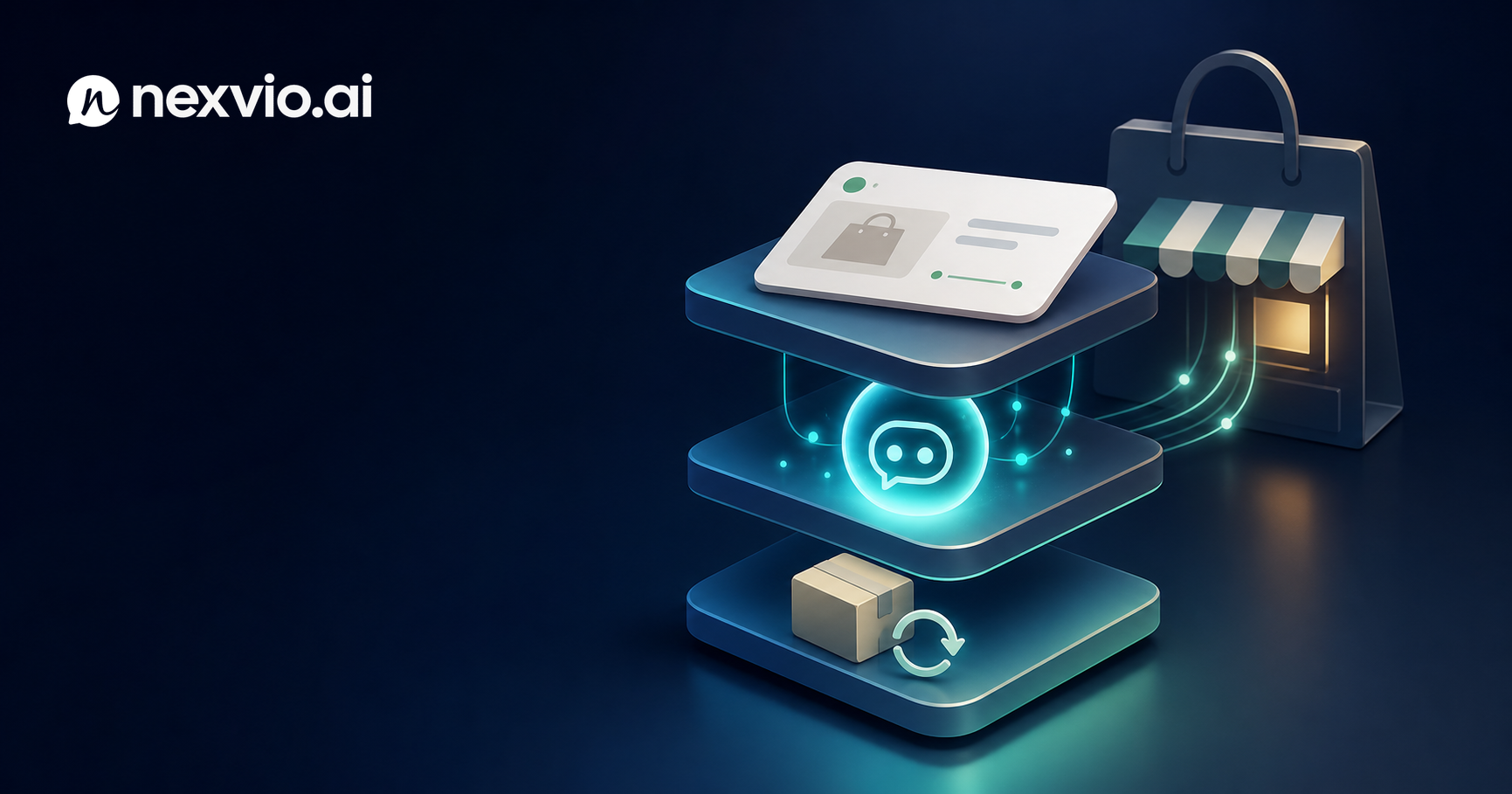
The modern ecommerce support stack has four functional layers, each dependent on the one beneath it:
- Data integration layer — connects your commerce, CRM, and logistics data to the AI
- AI resolution layer — answers questions, resolves transactional queries, and handles deflection
- Escalation and routing layer — moves complex cases to humans with context
- Analytics layer — measures outcomes and drives continuous improvement
Most ecommerce teams already have pieces of this stack. The challenge is usually not starting from zero — it is figuring out which pieces to replace, which to keep, and how to connect them so the AI has what it needs to actually resolve queries rather than just deflect them.
A stack that is missing the data integration layer is the most common failure mode. The AI can explain your return policy fluently, but it cannot tell the customer whether their specific order is eligible for return based on purchase date and product category. That limitation converts what should be a high-deflection deployment into one where the AI can only handle policy questions — dramatically reducing its value.
The Shopify-Native vs. Third-Party AI Decision
Shopify has expanded its AI capabilities considerably, and the question of whether to use Shopify-native AI tools or a third-party platform is a real one.
Shopify-native tools have one significant advantage: they are built on top of Shopify’s data model, which means order data, product data, and customer data are immediately available without integration work. The tradeoff is that native tools are generally less configurable, have shallower analytics, and may not cover non-Shopify data sources (your CRM, your 3PL’s logistics data, your helpdesk).
Third-party AI platforms require integration work to connect Shopify data, but they offer: deeper configurability, better analytics, support for multiple channels, integration with helpdesks and CRMs, and usually more sophisticated resolution capability for complex queries.
The right answer depends on your stack complexity. Pure Shopify shops with a single storefront and simple query patterns can get significant value from native tools. Shops with multiple storefronts, a separate CRM, a 3PL with its own data system, or omnichannel support needs will find third-party platforms provide substantially more capability at acceptable integration cost.
For teams that need deep Shopify data access with third-party AI flexibility, Nexvio’s Shopify integration provides native order data access without requiring custom development — it is worth evaluating before committing to custom integration work.
The 4 Layers of an Ecommerce AI Support Stack
Layer 1: Data Integration
This layer determines what the AI can actually know. At minimum, an ecommerce AI support system needs:
- Shopify order data: order status, line items, fulfillment status, tracking numbers, return eligibility, payment status
- Customer account data: order history, contact preferences, prior support interactions, loyalty tier
- Product data: current inventory, product details, variant information, and ideally SKU-level attributes relevant to support queries
- Logistics and fulfillment data: carrier tracking information, delivery exceptions, warehouse status (especially relevant for 3PL operations)
Without real-time access to order and fulfillment data, the AI cannot answer the two most common ecommerce queries — “where is my order” and “can I return this” — with any specificity. It can only explain general policy, which most customers could find on your website themselves.
The integration architecture matters: API-based integrations with live data access are substantially more valuable than nightly data syncs. A customer asking “where is my order” at 9 PM needs a current answer, not data from this morning.
Layer 2: AI Resolution
This is the AI itself — the system that takes a customer query, retrieves the relevant data, applies your policy knowledge, and produces a response. Key capability requirements for ecommerce:
- Transactional query resolution: answering order status, tracking, return eligibility, and refund status questions by actually looking up the order, not giving a generic policy response
- Policy and FAQ resolution: handling shipping policy, return policy, and product questions accurately
- Multi-turn conversation handling: ecommerce queries often involve follow-up questions (“what if I already opened the packaging?” after an initial return inquiry)
- Action capability (where needed): some deployments go beyond answering to acting — initiating return labels, sending replacement orders, or flagging accounts. This requires deeper integration and more governance but delivers significantly higher deflection rates
The resolution layer should be connected to the data integration layer in real time. A query about a specific order should trigger an actual data lookup, not a templated response.
Layer 3: Escalation and Routing
Not every query should be AI-resolved. A well-designed escalation layer in ecommerce includes:
- High-value order escalation: orders above a defined dollar threshold route to human review for return or refund authorization
- Fraud and chargeback routing: queries that involve disputed charges, potential fraud, or chargeback mentions route directly to a specialist team
- Emotionally elevated routing: customers who express significant frustration, who reference prior bad experiences, or who are threatening escalation route to human agents
- Complex fulfillment issues: queries involving multiple orders, multi-item partial fulfillments, or 3PL exceptions that require coordination across systems
- Out-of-scope product queries: technical questions the AI is not trained to handle
The escalation layer should pass full conversation context to the human agent — not just the original query but the entire conversation history, the data lookups that were performed, and any actions the AI took or attempted.
Layer 4: Analytics
Analytics in an ecommerce support stack should close the loop between what the AI is doing and how the operation is performing. The metrics that matter:
- Deflection rate by query category: which query types are being successfully deflected, which are not
- Escalation reason distribution: why are conversations escalating — is it a knowledge gap, a product type the AI struggles with, or an integration issue?
- Resolution quality by order type: does the AI perform differently on large orders, international orders, or certain product categories?
- Post-deflection contact rate: are customers who received AI resolution coming back to contact you again? If yes, the resolution was probably incomplete
- Seasonal volume and deflection patterns: how does AI performance change during peak periods (BFCM, holiday season, major sales)?
Analytics that only report volume and deflection rate leave too much optimization opportunity untapped.
Connecting Shopify Order Data to AI Answers
The integration between Shopify and your AI system is the most important technical decision in the stack. There are three common architectures:
Direct API integration: The AI platform queries Shopify’s Admin API in real time when a customer asks a relevant question. This provides live data but requires managing API rate limits and authentication.
Middleware/data sync: A middleware layer (like an iPaaS tool) syncs Shopify data to an accessible data store that the AI queries. This reduces API dependency but introduces data freshness risk.
Native platform integration: Some AI platforms have pre-built Shopify connectors that handle authentication, data mapping, and query execution without custom development. This is typically the lowest total cost of ownership for teams without dedicated engineering resources.
Whatever architecture you choose, test these specific scenarios before going live:
- Customer asks about an order placed in the last hour (freshness test)
- Customer asks about a split-shipment order (multi-record complexity)
- Customer asks about a return for an item purchased 35 days ago with a 30-day policy (policy calculation test)
- Customer asks about a recently cancelled and re-ordered item (state change handling)
These scenarios expose the most common integration edge cases before they appear in production.
Returns and Refund Automation in the Stack
Returns and refunds are the highest-volume high-stakes query category for most ecommerce brands. They are also where AI delivers the highest potential value and where poorly designed automation causes the most damage.
Effective returns and refund handling in an AI stack:
- Policy application: The AI should be able to determine return eligibility based on order data (purchase date, product category, order value) and your policy rules — not just describe the policy generically.
- Return initiation: Where your policy and tooling allow, the AI can initiate a return label request directly, completing the resolution in a single conversation without human involvement.
- Refund status: Customers asking about the status of a pending refund should get a real answer based on actual refund processing state — not “please allow 5–10 business days.”
- Exception routing: Orders outside standard policy (gifts, bulk orders, special circumstances) should route to human review rather than forcing the AI to make a judgment call.
The line between what AI should resolve autonomously and what should route to humans for returns should be defined explicitly in your stack configuration, not emergent from model behavior.
Channel Coverage: Where Ecommerce Customers Contact You
Ecommerce customers use every channel available to them, and they use them non-uniformly depending on the urgency and type of query:
- Live chat (on-site): highest for pre-purchase and urgent post-purchase queries
- Email: preferred for non-urgent matters and detailed inquiries (warranty claims, complex returns)
- WhatsApp and SMS: growing fastest, especially for order status and shipping notifications
- Social media DMs (Instagram, Facebook): high for post-purchase issues and product questions
- Phone: still relevant for high-value orders and emotionally elevated customers
Your AI stack should cover the channels your customers actually use, with consistent resolution capability across all of them. An AI that works well on live chat but cannot handle WhatsApp queries leaves a significant portion of your contact volume unaddressed.
The consistency requirement matters: customers who get an excellent AI experience on chat and a poor one on email will not average their experience — they will remember the bad one.
Integration Points: Shopify, Helpdesk, CRM, WhatsApp
The full integration map for a mature ecommerce AI support stack:
| System | What the AI needs | Integration priority |
|---|---|---|
| Shopify | Order status, return eligibility, product data | Critical |
| Helpdesk (Gorgias, Zendesk, Freshdesk) | Ticket creation, conversation history, SLA tracking | Critical |
| CRM or customer platform | Customer history, lifetime value, contact preferences | High |
| 3PL / logistics (ShipBob, etc.) | Real-time fulfillment and tracking data | High for brands with complex fulfillment |
| WhatsApp Business | Inbound and outbound messaging | High if WhatsApp is a supported channel |
| Review platform (Yotpo, etc.) | Product and service context | Medium |
| Subscription platform (Recharge, etc.) | Subscription status and billing | Medium-high for subscription brands |
Build the critical integrations first. Get the AI resolving the highest-volume queries (order status, returns, basic policy) before investing in lower-priority integrations. The marginal value of each additional integration decreases; start with the highest-value connections.
Stack Evaluation: What to Consolidate vs. Keep Separate
Ecommerce support teams typically arrive at the AI decision with an existing stack: a helpdesk, maybe a separate live chat tool, possibly a basic chatbot, and a handful of Zapier automations. The question is what to consolidate and what to keep.
Good candidates for consolidation under an AI platform:
- Basic chatbot (replace with AI resolution)
- Separate live chat tool (if the AI platform includes native live chat with escalation)
- Manual routing rules (if the AI platform’s escalation routing is more sophisticated)
Keep separate:
- Your helpdesk — the AI should integrate with it, not replace it. Helpdesks are where agent work lives, where SLA tracking happens, and where your compliance and audit trail resides.
- Your CRM — same logic; the AI reads from your CRM but does not replace it.
- Analytics and reporting tools — AI platform analytics should supplement, not replace, your operational reporting.
Over-consolidation is a common mistake. The goal is the right tools doing the right jobs, not the minimum number of tools.
The Total Cost of the Stack
Total stack cost includes more than platform fees. A realistic ecommerce AI support stack budget includes:
- AI platform license: typically per-resolution or volume-based pricing for mid-market teams
- Integration development: if native connectors do not exist, custom integration can run $5K–$30K depending on complexity
- Knowledge base development: creating the structured content that grounds AI responses — often 40–80 hours of internal labor
- Configuration and tuning: initial setup, test and iterate, ongoing optimization — typically 10–20 hours/month for a dedicated AI ops owner
- Helpdesk costs: your existing helpdesk remains in the stack; AI typically reduces seat count but rarely eliminates the tool
- Training: agents need to understand how to work with AI, how to review AI-handled conversations, and how to feed quality signals back into the system
Model this over 24 months, not just the first year. AI platform costs often decrease (per-resolution pricing gets cheaper at volume) while the value of deflection increases as more query types are covered.
FAQ
Do we need Shopify Plus for AI support integration? Not necessarily. Many AI platforms integrate with standard Shopify plans via the Admin API. Some advanced features (custom storefronts, B2B functionality, advanced checkout scripts) may require Shopify Plus, but core order data integration is available on most plans.
Can AI handle peak periods like Black Friday? AI is one of the strongest arguments for ecommerce teams facing BFCM spikes. Because AI scales without hiring, it can absorb 3–5x volume increases without proportional cost increases. The key is ensuring your knowledge base and integrations are updated before peak — a misconfigured AI during BFCM can do significant damage.
What is the right deflection rate target for ecommerce? For teams with strong Shopify data integration and a well-maintained knowledge base, 50–65% deflection is achievable in year one. Best-in-class ecommerce teams with returns automation and deep product data access reach 70–80%.
Should the AI handle refund approvals autonomously? For routine refund requests within policy (eligible items, within return window, no fraud signals), yes — autonomous approval and initiation is achievable and desirable. For edge cases, high-value orders, or any situation where the system is uncertain, route to human review. Draw the line explicitly rather than letting the AI decide.
How do we handle ecommerce queries in multiple languages? If your customer base is multilingual, your AI platform must support the languages your customers actually use. Test non-English resolution quality specifically — many platforms have significantly lower accuracy in secondary languages, particularly for transactional queries that require structured data retrieval.
Conclusion
The ecommerce support AI stack is not a single product decision — it is an architecture decision. The teams that get the most out of AI are the ones that built their stack deliberately: data integration first, then resolution capability, then escalation design, then analytics. Each layer depends on the one beneath it.
The good news is that Shopify makes data integration more accessible than most commerce platforms, and the high-volume, predictable nature of ecommerce queries (order status, returns, policy questions) is exactly what AI resolves most reliably.
If you want to see what a Shopify-integrated AI support stack looks like in practice, book a demo with Nexvio and ask specifically about the Shopify integration — we will show you exactly what data the AI can access and how that translates to resolution capability on your actual query types.